Pokerbros Review (2026)
PokerBros is one of the largest club-based mobile poker apps. Unlike traditional poker rooms, PokerBros isn’t a centralized operator — the app is simply the technical platform where admins create clubs that run games using virtual chips. In this review, we’ll give an honest, expert breakdown of PokerBros, covering the key points: traffic, game softness, real rakeback terms, payout methods, risks, pros, and cons.
For side-by-side context beyond this PokerBros review, see our PokerBros vs PPPoker vs ClubGG app comparison.
How PokerBros Works: Clubs and Unions (Alliances)
PokerBros isn’t a classic poker room — it’s a platform for playing in closed, private clubs. Any user can create their own club with custom rules, stakes, rake, and game schedules. Access to these clubs is invite-only.
To ensure enough action, clubs often merge into unions (alliances). In that setup, players from different clubs can end up at the same tables and enter the same tournaments. Large alliances can offer fairly stable traffic across a wide range of stakes.
PokerBros does not hold player funds and does not process financial transactions. All deposits and payouts are handled by club admins and agents. PokerBros positions itself as a social app with free play on virtual chips. Any monetization happens at the club/agent level.
Benefits of this model:
- Soft games: lots of recreational players from the US, Latin America, and Europe.
- Format flexibility: club admins can run pretty much any discipline, including Short Deck (6+), 5-card Omaha, OFC, and more.
- Anonymity: no verification required even when cashing out.
Risks:
- No centralized control: no regulator, no unified cashier, and no built-in protection system.
- Agent-dependent security: a bad agent can delay your payout — or refuse to pay.
- Uneven traffic: smaller unions may have empty tables at certain stakes.
PokerBros offers modern, reliable software, but your real safety depends entirely on the club and agent you choose. The platform itself doesn’t guarantee anything — responsibility sits with the people inside the ecosystem.

PokerBros vs Traditional Poker Rooms: Key Differences
PokerBros and traditional poker rooms (like PokerStars or GGPoker) are completely different models. To understand whether mobile club poker fits you, it’s important to compare them on the essentials.
Game softness. PokerBros lineups are generally weak because the ecosystem is mobile-first and not built around a pro-style grind. Many clubs even enforce VPIP limits, which makes the platform unfriendly for regs. In traditional rooms, games are tougher — especially at mid and high stakes.
Anonymity. PokerBros doesn’t require KYC or payment-method verification. You play under a nickname without revealing personal details. In classic rooms, cashing out almost always requires identity verification.
Rakeback level. In top PokerBros clubs, rakeback can reach 50%, often better than most mainstream loyalty programs.
Payments. On PokerBros, transaction safety depends on the reliability of the club and agent. On PokerStars or GGPoker, deposits and withdrawals go through a centralized cashier, and licensed rooms typically offer stronger protection as long as you follow the rules.
Traffic. Traditional rooms have stable, high traffic. PokerBros doesn’t have a single player pool — traffic is split across clubs and unions. That said, overall PokerBros activity can still be comparable to top poker rooms.
HUD use. Many poker rooms allow third-party trackers. PokerBros officially forbids them. However, some players still collect stats and display a HUD via converters.
PokerBros Clubs and Agents: What Players Need to Know
In the PokerBros ecosystem, real action revolves around two key roles: club admins and agents. Understanding who does what is crucial if you want to play safely and profitably.
Admins are the private club owners. They build player pools, set rules, rake, and stakes. Some admins run multiple clubs inside large communities.
Agents are the middlemen between the player and the club. Through agents you deposit and cash out, get access to specific unions/clubs, negotiate rakeback terms, and solve technical and financial issues.
PokerBros doesn’t deal with players directly when it comes to money. All chip-to-cash arrangements are private agreements between you, the club, and the agent — which is why choosing the right agent is your #1 security decision.
What to check when choosing a club:
- Club reputation — look for long-running partners with transparent terms.
- Union size and activity — more active players = more tables and tournaments at any hour.
- Payout history — join clubs that pay consistently and on time.
- Operational stability — reliable clubs run regularly without long outages.
Agents matter just as much. With a bad agent, you’ll face constant payout delays — or lose your funds entirely.
AppPokerDeals is a trusted agent with over 10 years of successful experience working with mobile club poker apps. We work only with vetted, reliable clubs. Through us, you’ll get access to the softest lineups and strong rakeback deals — plus 24/7 player support.
Rake and Rakeback on PokerBros: Real Conditions in 2026
PokerBros doesn’t have a universal rake structure — rake is set by club admins, not by the platform. In most clubs, average rake ranges from 5% to 8%, which is higher than in top traditional rooms. The rake cap is often around 1–2 BB, but some tables are uncapped, meaning the fee can be taken without a maximum limit.
Rakeback is not paid directly by PokerBros. The rakeback system is arranged through the agent you agree with before you start playing. The agent sets the rakeback percentage, payout frequency, and calculation method. In practice, rakeback typically falls in the 25% to 50% range.
PokerBros Bonuses and Promotions
There’s no welcome bonus on PokerBros because it’s not a poker room in the traditional sense. Officially, the app runs on play chips, so it can’t offer cash bonuses. However, private clubs and agents can run their own promos.
The most common promo is recurring jackpots, including Bad Beat jackpots. Prize pools can reach an impressive $50,000.
Some clubs also run special offers like tournament series with boosted guarantees, newbie freerolls, or increased rakeback. These promos are local to specific clubs and don’t apply platform-wide. So PokerBros doesn’t have classic poker-room bonuses — but with high rakeback and jackpots in reputable clubs, the action can still be very profitable and fun.
Jackpots Up to $50,000
All PokerBros cash tables participate in a jackpot pool shown above the table window. The most common jackpot types are Bad Beat and High Hand. The prize pool is funded by a small extra fee taken from each hand.
A Bad Beat jackpot is paid when a player loses with a monster hand (for example, quads or better). In large unions, the jackpot can reach $50,000, but real numbers depend on how long the pool has been building and how active the chosen stake is. In small clubs, jackpots may be only a few hundred dollars. Rules and payout conditions vary by club and can differ significantly.
Games and Traffic on PokerBros
PokerBros is one of the most active mobile poker apps. Average online is around 20,000–30,000 connections. Peak traffic usually hits in the evening in Central American time. Thanks to big alliances in multiple regions, there’s action 24/7 — the key is choosing a club that peaks when you play.
PokerBros spreads all major formats. The most common game is No-Limit Texas Hold’em. NLH runs from NL10 up to NL1K, with higher tables sometimes appearing up to NL5K. Omaha is also widely available, including 5-card Omaha, with stakes ranging from roughly 10 up to 1K. MTTs can carry guarantees up to tens of thousands. PokerBros is also one of the few places you’ll find Open-Face Chinese (OFC) tables. Short Deck (6+) is growing globally and is available here as well.
Cash Games (Hold’em, Omaha, OFC, Short Deck)
Hold’em and Omaha are the two most popular formats on PokerBros. At NL10–NL50, you’ll regularly see up to 42 tables. At the same stakes, Omaha runs around 12 tables. NL50–NL100 typically has about 18 full tables, while PLO50–PLO100 is less popular (around 6 tables). At NL100–NL300 and NL300–NL500, you’ll see roughly 10 tables on average, with 3–4 Omaha tables at those stakes.
At stakes of $1,000+, Omaha can actually overtake Hold’em — about 4 tables vs 2.
Besides standard PLO, 5-card Omaha is quite popular on PokerBros. OFC exists but isn’t available in every club. Short Deck Hold’em isn’t especially popular and is mostly found at low and mid stakes.
Tournaments: MTTs and SNGs
As the largest US alliances like Diamond and Sapphire expand, MTTs are becoming more popular on PokerBros. These groups can connect into super-alliances, allowing MTTs to generate huge fields and big guarantees (up to $500,000).
Beyond the US scene, Brazilian clubs also run MTTs regularly. Formats range from classic freezeouts to progressive knockouts.
SNGs are available too, but traffic is relatively low. Most common formats are heads-up and 6-max. Tournament volume and quality depend heavily on the club you play in. Small isolated clubs run MTTs rarely and with small (or no) guarantees, while large alliances — especially US and Brazilian — can host regular MTT schedules and full festival series across many buy-ins.
How Soft Are PokerBros Games?
In terms of lineup softness, PokerBros is one of the most attractive platforms out there. Skill level varies by club, but overall PokerBros is known for very weak fields. Key reasons:
- Invite-only clubs and no KYC, which attracts recreational players who value anonymity.
- Mobile-first play — lots of players are on phones in suboptimal conditions (travel, work, etc.).
- Geographic variety — you can find alliances from regions where poker skill levels are generally lower.
- HUD restrictions — even though workarounds exist, the risk of bans discourages many regs.
The average skill level still depends on the specific union, but overall PokerBros fields are much softer than in mainstream rooms.
PokerBros’ Attitude Toward Pros
PokerBros maintains a strict anti-PRO policy designed to protect recreational players and keep the ecosystem healthy. That’s why the platform bans:
- HUDs and trackers.
- Bots and automation scripts.
- Real-time GTO solvers.
- Bumhunting scripts.
Enforcement happens both at the app level (PokerBros doesn’t provide hand histories and blocks external integrations) and at the club/union level (which may have its own security team). Big unions actively monitor the reg-to-rec ratio, and agents whose players “damage the ecology” can be removed. As a result, it’s harder for professionals to farm on PokerBros than in traditional rooms.
PokerBros Software: Mobile Client and PC Play
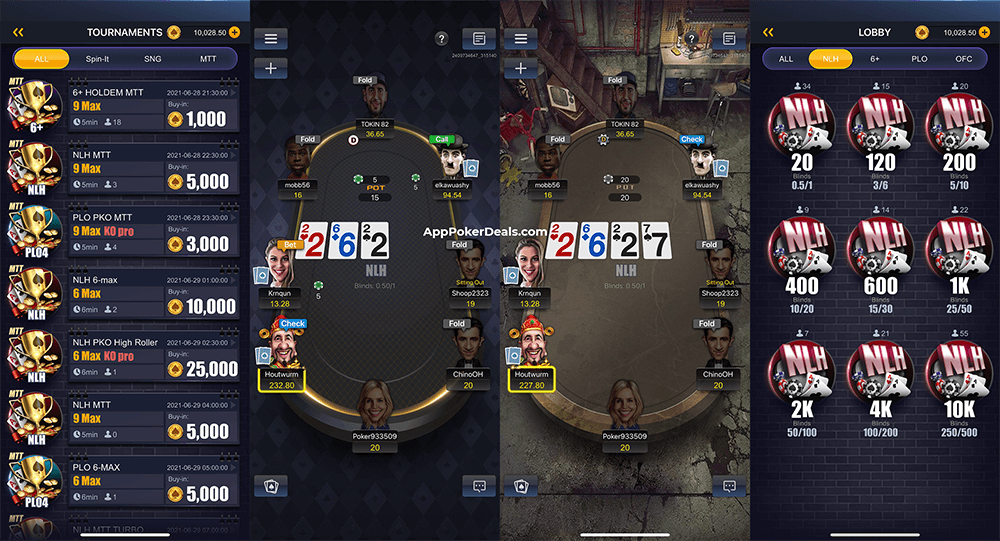
PokerBros was built as a mobile-first app. You can download it from official stores on iOS and Android. The client is minimalist and user-friendly, with portrait-mode tables — perfect for mobile play.
Core features include a vertical bet slider, a numeric keypad for entering amounts, quick bet buttons (2 BB, all-in), and a set of fun emojis. You can display stacks in money or blinds, choose from several table themes, and play up to four tables at once on one device.
Playing on PC: Officially vs Emulators
PokerBros does not offer a desktop client — only mobile apps. So there’s no official way to play on PC. However, Android emulators can make it possible. Using BlueStacks or LDPlayer, you can run PokerBros on a computer and use the full mobile feature set.
Pros of playing via emulators:
- Easier control with a large screen and mouse
- More comfortable multitabling compared to switching tables on a phone
- Ability to use various helpers and solvers
- Access to all mobile app functions
Cons:
- Higher system requirements (a solid PC is needed for 4-tabling smoothly)
- Some clubs ban emulator users and may confiscate funds
- Some antivirus tools flag emulators as unwanted software, which can cause instability
Does a HUD Work on PokerBros?
HUDs are officially forbidden on PokerBros. The platform doesn’t provide hand histories and doesn’t support third-party tracker integration. There’s also no built-in HUD — this is part of the broader policy to protect recreational players and maintain ecosystem balance.
That said, some workarounds exist to collect opponent stats. This violates platform rules and may lead to an account ban, but some regs still take the risk using specialized converters.
Reliability and Security on PokerBros
PokerBros presents itself as a social gaming platform and does not officially offer real-money services. That means platform representatives take no responsibility for money movement. Any monetization happens outside the app through independent agents and club reps — so financial safety depends entirely on club/agent reputation.
Technically, PokerBros is stable: it’s updated regularly, runs fast, and is generally glitch-free. The RNG is certified by three independent labs. PokerBros’ internal security fights bots and cheaters активно. However, these protections cover game integrity — not your money. If you have a dispute with an agent or a club holds your funds, PokerBros support typically can’t intervene.
How to minimize risk:
- Play only in large, reputable unions with long, transparent payout histories.
- Start with a small test deposit.
- Work only with trusted agents with years of proven track record.
- Avoid “too good to be true” offers — unusually high rakeback and huge bonuses often signal scams.
PokerBros is technically solid, but financially it’s not protected by default. Safety is not a platform feature — it’s a club/agent responsibility.
Deposits and Withdrawals: How to Buy Chips on PokerBros
There’s no direct cashier in PokerBros — all payments are P2P through agents. Payment methods can vary widely depending on the agent. If you want a step-by-step guide on how to get started playing PokerBros for money, the process is covered in detail there.
Typically, deposits and cashouts are done via crypto (USDT, BTC, ETH), e-wallets, or bank transfers. The minimum deposit is usually $50, but it can vary by club. Transaction speed also depends on the club/agent.
To reduce risk when moving money, follow these guidelines:
- Check club activity before depositing — stable traffic is often a good sign.
- Make a test deposit to confirm payout speed.
- Avoid anonymous agents with no reputation.
- Clarify all terms in advance.
Should You Play on PokerBros? Our Verdict
PokerBros remains one of the most popular options for players looking for soft lineups and flexible formats. It offers strong traffic from the US, Latin America, and Europe, a wide range of games (including PLO5 and OFC), and some of the softest fields in online poker. But profitability comes with real risk: it’s not a regulated room, and all financial operations go through agents.
That said, with the right club selection and a reliable agent, you can reduce those risks significantly. In that case, PokerBros can be both safe enough and highly profitable.
PokerBros Pros and Cons
Pros:
- One of the softest fields in online poker.
- High-quality, feature-rich mobile client.
- Thousands of cash tables running 24/7.
- Tons of recreational players from the US and Latin America.
- Big MTTs with guarantees up to $500K.
Cons:
- Not comfortable for PC play.
- High system requirements (if using emulators).
- No native HUD support.
- No direct cashier — payments only through agents.
PokerBros is a great fit for poker fans who prefer grinding on a phone in very soft lineups. It’s not for every pro — you’ll need to adapt to portrait tables, the club model, no HUD, and agent-based payments.
Benefits of Playing Through Our Service (Clubs, Rakeback, Payouts)
AppPokerDeals has years of successful partnership experience with major poker platforms, including PokerBros. Our managers can secure comfortable, +EV playing conditions on PokerBros.
Players who join through our agents can expect:
- Club подбор based on your preferences and stakes.
- Only vetted, reliable clubs.
- Safe payments and fast, on-time withdrawals.
- 24/7 support, 7 days a week.
- High rakeback with transparent calculations.
PokerBros FAQ
How safe is it to play?
Safety depends entirely on the clubs you choose and the agents you work with.
What are clubs and unions?
A club is a private poker community created by an admin on PokerBros. Access is invite-only. A union is a group of multiple clubs объединённых to increase traffic.
How do deposits and cashouts work on PokerBros?
All money movement happens outside the app through an agent. Crypto is commonly used, especially USDT.
Does a HUD work?
The app doesn’t provide hand histories and doesn’t support third-party software. Using workarounds violates the rules and can result in a ban.
Which games are most popular?
Hold’em and Omaha (including 5-card) are the most common. Short Deck (6+) and OFC are less common.
How is PokerBros different from PPPoker?
Both use a club-based ecosystem, but they differ in traffic geography and app implementation.
Are there international unions?
Yes, PokerBros has large international unions that объединяют clubs from multiple countries.
General Information
| 🎖️ Established | 2019 |
| 🪪 License | Unlicensed |
| 💰 Rakeback | up to 50% |
| 💳 Rake | 5% |
| 🏧 Cashier | via agent |